Ready to see what M.E.B.A. can do for your career?
Six steps. $150 to start. The best pension, healthcare, and training in the industry from day one. Download the application or find your nearest hall.

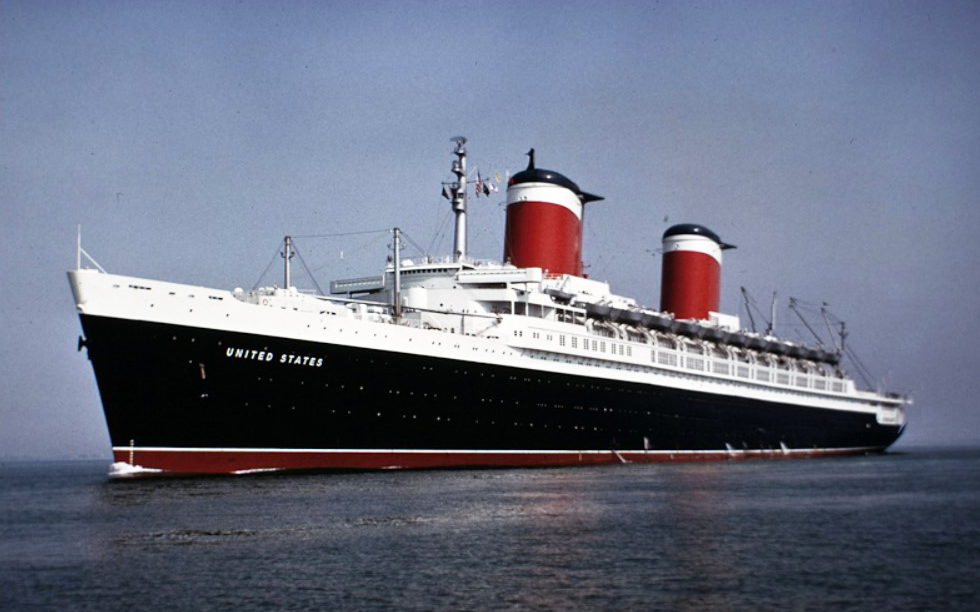
The SS UNITED STATES, the legendary ocean liner that once represented the pinnacle of American maritime engineering and speed, has made her final voyage. The historic vessel was deliberately sunk on the evening of November 11 off the Florida panhandle, beginning a new chapter as the world’s largest artificial reef. Her final resting place is about 25 nautical miles southwest of Destin-Fort Walton Beach. For those who sailed aboard her, worked in her engine rooms, or simply followed her remarkable history, the news brings a measure of sadness. The “Big U” was more than a ship. She was a symbol of American ingenuity, national pride and the skilled American mariners who kept her moving.
That connection runs deep within the M.E.B.A. During the liner’s heyday in the 1950s and 1960s, M.E.B.A. officers filled both engine rooms, playing a vital role in operating one of the most technologically advanced passenger ships ever built. Her powerful machinery helped propel her to a speed record that has stood for generations. On her 1952 maiden voyage, the 990-foot liner shattered the transatlantic speed record, crossing from New York to Bishop Rock off Cornwall in just 3 days, 10 hours and 40 minutes. She captured the prestigious Blue Riband for the fastest westbound Atlantic crossing, a distinction she still holds. The Big U carried four U.S. presidents — Harry Truman, Dwight Eisenhower, John F. Kennedy and Bill Clinton — along with foreign dignitaries, Hollywood stars, business leaders, military officials and thousands of everyday Americans and immigrants. Her career came to an end in 1969, but efforts to find a new purpose for the vessel continued for decades.
For years, the SS United States Conservancy fought to preserve the ship as a museum and national landmark. After years of unsuccessful redevelopment proposals and mounting financial pressures, that dream ultimately gave way to a plan to transform the liner into an artificial reef rather than see her dismantled for scrap. The $13.5 million project, organized by Okaloosa County, Florida, and its contractors, culminated when the vessel finally slipped beneath the Gulf waters in the darkness around 9 pm. Crews prepared the ship by removing hazardous materials, opening sections of the decks and removing more than 400 portholes. Her two iconic smokestacks were also removed and are expected to become part of a future museum honoring the liner.
The ship rests in approximately 180 feet of water, with her upper decks accessible to divers. At 990 feet long, she surpasses the USS ORISKANY, the former aircraft carrier sunk off Pensacola in 2006, to become the largest vessel ever deliberately sunk as an artificial reef. It is an unusual final chapter for a ship that once carried America’s flag across the Atlantic at record-breaking speed. But while the Big U will no longer cross oceans, her steel hull will provide a new home for marine life and a destination for generations of divers and fishing enthusiasts.
For the M.E.B.A. officers who stood watch in her engine rooms, and the many members who remember what she represented, there will undoubtedly be a tear shed as the news sinks in. The ship that once embodied the strength of American maritime engineering has taken her final watch beneath the waves. Her legacy, however, remains very much afloat.
Six steps. $150 to start. The best pension, healthcare, and training in the industry from day one. Download the application or find your nearest hall.